01
Keep the evidence
Preserve sources, telemetry, decisions, and provenance so an answer can be understood rather than merely admired.
Dangerous Metrics is an evolving home for practical work at the intersection of data, infrastructure, and AI-assisted reasoning.
The interesting work is rarely just the model. It is the evidence around the model, the tools it can reach, the history it can retain, and the human decisions that keep the whole thing honest.
Preserve sources, telemetry, decisions, and provenance so an answer can be understood rather than merely admired.
Bring search, archives, services, agents, workflows, and ordinary system tools into one observable working environment.
Automate what is safe. Review what matters. Keep the system capable without making it careless.
The model is a component. The data, context, and operating discipline are the system.
GoatMUX is an evolving AI agent orchestration system: a persistent environment where agents can search accumulated material, use specialized tools, run controlled workflows, preserve their results, and be evaluated against what actually happened. Different models can participate without replacing the evidence underneath them.
It is part research lab, part infrastructure project, and part ongoing argument with the assumption that a clever answer is the same thing as understanding.
Visit GoatMUXGoatMUX is a Go-based service layer for AI control and orchestration. It gives agents bounded, cataloged access to files, archives, search, telemetry, inference services, image generation, Ghost publishing, and workflow state. The API is the control surface; MariaDB holds authoritative metadata, OpenSearch provides full-text and vector retrieval, and the filesystem remains the source of truth.
Agents do not receive an unstructured shell of hidden capabilities. They use explicit endpoints, actor identity, bounded reads, pagination, and operation records. That makes a useful distinction between what an agent found, what it inferred, and what it was authorized to change.
The routes below are the agent-facing surface documented in the current API catalog. Availability and permissions are enforced by GoatMUX; an endpoint being listed does not grant an agent permission to use it.
GET /api/catalog/scopeGET /api/catalog/tree-summaryGET /api/archive/inspectGET /api/source/readGET /api/browseGET /api/fileGET /api/mountsGET /api/workspaceGET /api/searchGET /api/content-searchGET /api/content-vector-searchGET /api/content-chunkGET /api/research/index-searchGET /api/research/index-filename-matchGET /api/research/randomGET /api/research/webGET /api/gdelt/searchPOST /api/v1/operationsPOST /api/v1/operations/{id}/eventsGET /api/memory/searchGET /api/memory/compareGET /api/operationsGET /api/system-statusGET /api/healthGET /api/telemetry/currentGET /api/telemetryGET /api/public/statusGET /api/public/eventsGET /api/public/telemetryGET /api/v1/edge-logsGET /api/v1/site-metricsGET /api/v1/inference/ollama/modelsPOST /api/v1/inference/ollama/chatPOST /api/v1/inference/ollama/embeddingsGET /api/v1/inference/comfyui/statusPOST /api/v1/inference/comfyui/text-to-imageGET /api/v1/inference/comfyui/jobs/{id}GET /api/v1/workflow-templatesGET /api/v1/workflow-resourcesGET /api/v1/workflowsPOST /api/v1/workflows/{id}/runsGET /api/v1/workflow-runs/{id}/steps/{step}/eventsGET /api/v1/workflow-agents/{agent}/persona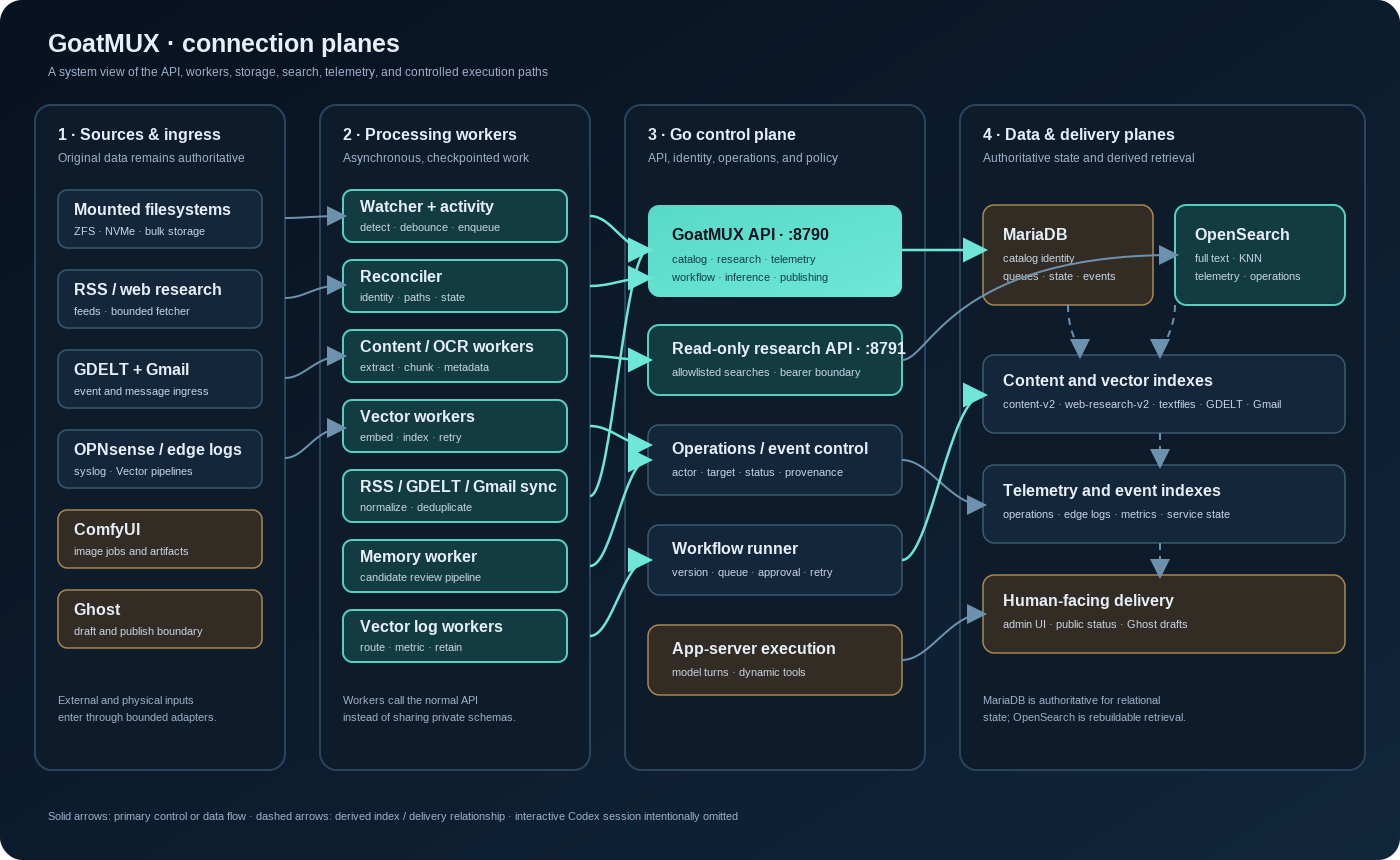
What is being looked at: The left plane is where information enters: mounted files, RSS and web research, GDELT, Gmail, router logs, ComfyUI, and Ghost. The next plane is the worker layer. Watchers and reconcilers identify changes, content and OCR workers extract text, vector workers create embeddings, and source-specific sync workers normalize feeds and messages. They communicate through the Go API rather than reaching into each other's private databases.
The center is the control plane: the normal Go API on port 8790 handles catalog, research, telemetry, workflow, inference, publishing, and operation requests. The read-only research listener on 8791 exposes a narrower search boundary. The operation/event stream records who did what, to which target, and whether it completed. The workflow runner versions execution plans, queues runs, applies approval gates, invokes model turns through the Codex App Server, and preserves bounded transcripts.
The right plane separates durable truth from derived retrieval. MariaDB is authoritative for relational identity, queue state, workflow state, and event history. OpenSearch holds rebuildable full-text, KNN, telemetry, edge-log, and operation indexes. The admin interface and public status views read through the API, while Ghost remains an explicit delivery boundary. Solid arrows show primary control or data flow; dashed arrows show derived indexing and delivery relationships.
A workflow defines a versioned sequence of research, model, tool, image, and publishing steps. A draft is saved, reviewed, and published before it can run. Queuing a run creates a durable run record; workers execute each step with the assigned persona and model, pass bounded outputs forward, and preserve artifacts in the agent workspace. Long-running work can be paused for human approval rather than silently continuing.
Every meaningful action produces an operation or event record: request metadata, actor, target, status, source identifiers, model information, tool calls, outputs, errors, and timing where available. Model-step Codex messages are retained as bounded execution events. You can see a public sample of that stream in the Events section of GoatMUX.